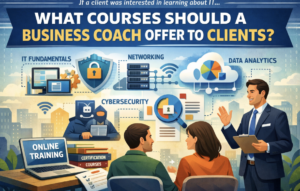
Every business coach eventually meets the client who says they want to “learn IT” because they can feel the ground shifting under their industry. Customers expect faster service, competitors automate faster, teams collaborate in the cloud, and cyber risk is no longer an abstract problem. In 2026, business leaders are watching tech budgets surge—especially around AI and cloud—because the companies that learn to run technology well tend to out-execute the companies that treat it like a back-office utility. A business coach can turn that pressure into momentum by offering a clear, structured set of IT-focused courses that translate technology into business outcomes, stronger operations, and smarter decision-making.
Below is a practical course lineup a business coach can offer, organized as a “menu” that works for owners, managers, and future leaders. Each course is designed to build confidence and capability without turning your coaching program into a computer science degree.
Course Track 1: IT Business Fundamentals and Digital Strategy
Start clients with the “why” and “how” of business technology—what IT is, how it creates value, and how leaders make decisions about it. This course should teach the language of modern IT: systems, platforms, infrastructure, applications, data, security, governance, and vendor ecosystems. More importantly, it should connect IT to customer experience, profitability, speed, and resilience.
A strong foundation module also explains digital transformation as an ongoing operating model change—not a one-time software purchase. You can anchor this section with a plain-English overview of what digital transformation means at the organizational level using a neutral reference like Digital transformation (Wikipedia). From there, turn it into coaching-driven work: define business goals, map the workflow bottlenecks, identify where technology removes friction, and create a 90-day “tech-to-results” plan the client can execute.
Key outcomes for clients include better decision-making, clearer prioritization, and the ability to evaluate technology based on ROI, not hype.
Course Track 2: AI for Business Leaders and Workflow Automation
AI is no longer a future topic; it is a budget and leadership topic. Many companies are increasing spending as they chase productivity gains, new products, and competitive advantage, while investors and boards push for measurable returns. A business-coach course should focus on practical AI literacy: what generative AI is, where it fits, what it cannot do, and how to adopt it responsibly.
Use a current business-news framing to keep the course grounded in reality, such as the wave of AI and cloud investment discussed in Reuters’ report on Big Tech AI spending and cloud growth. Then translate that macro trend into the client’s world: identify 3–5 workflows where AI can reduce cycle time, improve service consistency, or increase output quality.
Course modules can include:
-
AI use cases by department (sales, service, finance, ops, HR)
-
Prompting as management communication (clear inputs, clear outputs)
-
Building an “AI policy” for staff behavior and confidentiality
-
Human-in-the-loop quality control
-
Measuring impact with simple scorecards
This course works best when paired with implementation coaching: set guardrails, pick one workflow, run a two-week pilot, measure results, and scale.
Course Track 3: Cybersecurity, Risk, and Business Continuity
Clients do not need to become security engineers. They do need to become leaders who understand risk, accountability, and operational continuity. A strong course teaches the reality that cyber risk is a business risk—financial, reputational, legal, and operational.
Ground your course content in authoritative research written for business leaders, such as the World Economic Forum’s Global Cybersecurity Outlook 2026 (PDF). Use it to support key lessons: common threat patterns, leadership blind spots, and what resilient organizations do differently.
Course modules can include:
-
Identity and access management basics (who can access what)
-
Phishing and fraud trends, including AI-enabled attacks
-
Ransomware readiness and recovery planning
-
Vendor risk management for SaaS tools
-
Minimum viable security controls for small and midsize firms
-
Incident response roles: who decides, who communicates, what gets shut down
Teach clients how to build a practical “security rhythm”: quarterly risk reviews, annual tabletop exercises, and clear ownership for critical systems. Done well, this course increases calm, confidence, and preparedness.
Course Track 4: Cloud, Modern Collaboration, and Data Stewardship
Many clients equate “cloud” with “we use some apps.” This course helps them see cloud as an operating model: scalable infrastructure, subscription software, distributed collaboration, and faster experimentation.
Bring in credible trend coverage aimed at leaders, such as InformationWeek’s cloud computing trends leaders should watch in 2026. Then coach clients through practical decisions: where cloud reduces friction, where it increases complexity, and how to avoid tool sprawl.
Course modules can include:
-
Cloud basics: SaaS vs PaaS vs IaaS, explained through business examples
-
Collaboration maturity: file governance, version control habits, meeting hygiene
-
Data stewardship: data ownership, retention, permissions, and quality
-
Shadow IT and app sprawl: how to simplify without slowing the team down
-
Cloud cost control: usage, licensing, and accountability
The leadership win here is clarity. Clients stop collecting tools and start building a coherent “digital workplace” that supports how the company actually operates.
Course Track 5: IT Leadership and the CIO Mindset for Owners
Business coaches can offer a powerful course that helps owners think like CIOs even if they never hire one. The focus is leadership: priorities, governance, execution, talent, and alignment.
A strong anchor for this section is a current, role-specific view of what technology leaders are prioritizing, such as CIO.com’s “Top priorities for CIOs in 2026”. Use this to show clients what serious operators pay attention to: identity, security, employee experience, modernization, data, and measurable value delivery.
Course modules can include:
-
Building an IT roadmap tied to business goals
-
Choosing metrics that matter (uptime, cycle time, customer impact, cost-to-serve)
-
Creating a governance cadence (monthly reviews, quarterly priorities, annual planning)
-
Running technology projects with accountability
-
Avoiding “initiative overload” and protecting team capacity
This course also helps clients lead internal IT staff and vendors without micromanaging. They learn to ask better questions, set clearer expectations, and make more confident tradeoffs.
Course Track 6: Technology Governance, Ethics, and Compliance in the AI Era
Modern IT is increasingly shaped by rules, audits, industry requirements, and public expectations. Leaders do not need legal training, but they do need governance instincts—especially as AI becomes embedded in customer experiences and internal decision-making.
This course should cover:
-
Basic governance frameworks: policies, access controls, approvals, documentation
-
AI governance: acceptable use, confidentiality, bias awareness, and oversight
-
Vendor due diligence: data handling, security posture, contract essentials
-
Privacy fundamentals: what data is sensitive and how to protect it operationally
-
Audit readiness habits: simple documentation that prevents chaos later
To connect governance to real-world technology direction, reference a forward-looking industry lens on enterprise trends such as Gartner’s Top Strategic Technology Trends for 2026. The goal is not to chase every trend; the goal is to help clients build a decision framework so the business can adopt technology safely and deliberately.
Course Track 7: IT Financial Literacy and Vendor Management
For many clients, the biggest pain is not technology—it is paying for technology they do not fully use, renewing tools they no longer need, and buying solutions without a clear plan. This course equips leaders to manage IT like an investment portfolio.
Course modules can include:
-
Total cost of ownership basics (licenses, implementation, training, change management)
-
Budgeting and forecasting for subscriptions and scaling usage
-
ROI measurement: time saved, errors reduced, revenue protected, retention improved
-
Vendor scorecards: performance, support, security, strategic fit
-
Negotiation basics: renewal cycles, consolidation strategies, and contract clarity
This is where coaching is especially valuable. Clients often know something feels wasteful; they need structure and accountability to simplify, renegotiate, and reinvest wisely.
Conclusion
What courses should a business coach offer to clients who want IT learning in a way that feels empowering instead of overwhelming by packaging courses around business outcomes: strategy, AI adoption, cybersecurity resilience, cloud operations, leadership execution, governance, and financial discipline. The result is a client who can lead in the modern economy with confidence—able to choose tools intentionally, protect the business, and turn technology into measurable momentum. When your course menu is structured as real-world leadership training rather than technical trivia, you become the coach who helps clients run the future instead of reacting to it.